When working in a laboratory, choosing the right glassware is essential for obtaining accurate results and ensuring safety. Two of the most commonly used laboratory vessels are the beaker and the conical flask (Erlenmeyer flask). Although they may appear similar at first glance, each is designed for specific laboratory applications.In this guide, we'll compare beakers and conical flasks, explain their uses, advantages, and limitations, and help you determine which one is best suited for your experiment.
What is a Beaker?
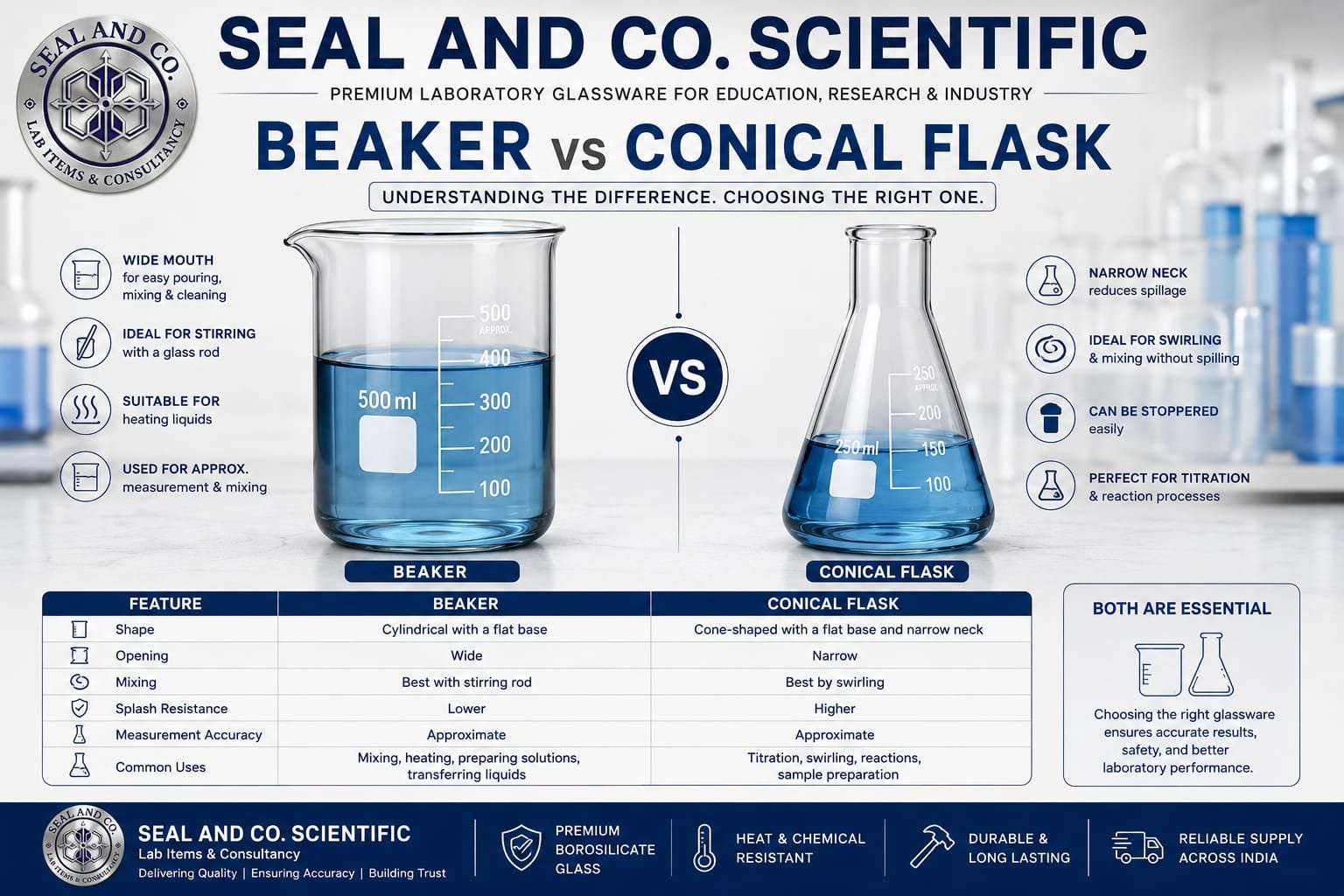
A beaker is a cylindrical laboratory container with a flat bottom and a pouring spout. It is one of the most versatile pieces of laboratory glassware and is commonly used in chemistry, biology, pharmaceutical, educational, and industrial laboratories.
Common Uses of a Beaker
Mixing chemicals
Heating liquids
Preparing solutions
Measuring approximate liquid volumes
Collecting and transferring liquids
Dissolving solids
Advantages of a Beaker
✔ Easy to pour due to the spout
✔ Wide opening allows easy stirring
✔ Available in glass or plastic
✔ Suitable for heating on hot plates or burners
✔ Easy to clean
Limitations
Not suitable for accurate volume measurements.
Liquid may splash during vigorous mixing.
Greater evaporation because of the wide opening.
Looking for premium laboratory beakers?
SEAL AND CO. SCIENTIFIC offers borosilicate glass beakers in multiple capacities including 50 ml, 100 ml, 250 ml, 500 ml, and 1000 ml. Our products are suitable for schools, colleges, diagnostic laboratories, pharmaceutical companies, and industrial laboratories.
What is a Conical Flask?
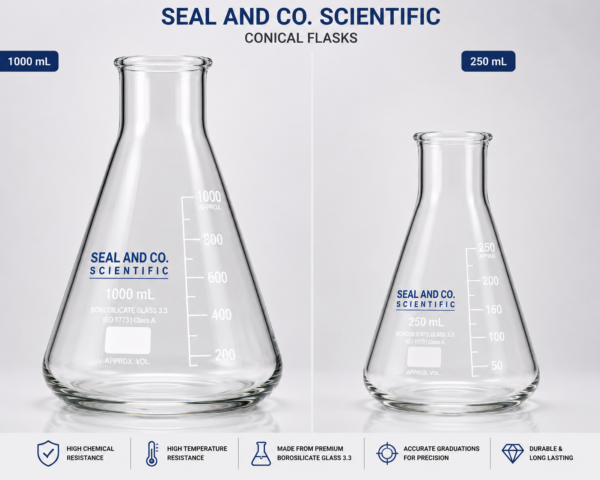
A conical flask, also known as an Erlenmeyer flask, features a flat bottom, cone-shaped body, and narrow neck. It is specifically designed for mixing liquids without spilling and is widely used in laboratories for titration, microbiology, and solution preparation.
Common Uses of a Conical Flask
Swirling chemical solutions
Titration experiments
Preparing culture media
Growing microbial cultures
Temporary storage of chemicals
Heating and boiling liquids
Advantages of a Conical Flask
✔ Narrow neck reduces splashing
✔ Ideal for mixing by swirling
✔ Minimizes contamination
✔ Reduces evaporation
✔ Can be fitted with rubber stoppers or caps
Limitations
More difficult to clean than a beaker
Less convenient for pouring liquids
Approximate volume markings only
Need high-quality conical flasks?
Explore our range of borosilicate conical flasks available in various capacities for chemistry laboratories, water testing laboratories, and research facilities.
Which One Should You Choose?
Choose a Beaker if you need to:
Heat liquids
Mix solutions with a stirring rod
Measure approximate volumes
Transfer liquids easily
Prepare reagents
Choose a Conical Flask if you need to:
Perform titration
Swirl liquids safely
Reduce chemical splashing
Store prepared solutions
Grow microbial cultures
Minimize evaporation
Applications Across Different Industries
Educational Laboratories
Schools and colleges commonly use both beakers and conical flasks for chemistry practicals and science demonstrations.
Water Testing Laboratories
Both are used for sample preparation, reagent mixing, pH testing, COD/BOD analysis, and chemical dosing.
Pharmaceutical Industry
Used during formulation, chemical preparation, and quality control testing.
Chemical Manufacturing
Essential for process development, analytical testing, and research laboratories.
Food & Beverage Laboratories
Used in quality assurance and microbiological testing.
Environmental Laboratories
Widely used for wastewater, drinking water, and environmental sample analysis.
Can a Beaker Replace a Conical Flask?
Not always.
While both can hold and heat liquids, a beaker is not an ideal replacement for a conical flask in experiments requiring vigorous mixing, titration, or contamination control.
Similarly, a conical flask is less convenient when easy pouring and frequent stirring are required.
Professional laboratories typically use both types of glassware depending on the application.
Tips for Choosing High-Quality Laboratory Glassware
Borosilicate glass for superior heat resistance
Clear graduation markings
Uniform wall thicknessChemical resistance
Durable construction
Smooth pouring spout
Compliance with laboratory standards.
Quality laboratory glassware improves safety, durability, and experimental accuracy.
Two of the most commonly used laboratory vessels are our Laboratory Beakers and Conical Flasks, both manufactured from high-quality borosilicate glass.
Frequently Asked Questions (FAQs)
Is a beaker more accurate than a conical flask?
No. Both provide only approximate volume measurements. For precise measurements, use volumetric flasks, burettes, or graduated cylinders.
Can both be heated?
Yes. Borosilicate glass beakers and conical flasks are designed to withstand laboratory heating.
Why is a conical flask preferred for titration?
Its narrow neck allows solutions to be swirled without spilling, making titration safer and more accurate.
Which is better for mixing chemicals?
For stirring with a glass rod, a beaker is more convenient. For swirling solutions, a conical flask is the better choice.
Which one should a laboratory purchase?
Most laboratories require both. Beakers are ideal for general-purpose work, while conical flasks are essential for titration, microbiology, and analytical chemistry.
Conclusion
Although beakers and conical flasks serve similar purposes, they are designed for different laboratory tasks. A beaker is the preferred choice for heating, mixing, and transferring liquids, while a conical flask excels in swirling, titration, and reducing spills.
Selecting the right laboratory glassware not only improves efficiency but also enhances the accuracy and safety of your experiments.