
Choosing the right weighing balance is important for any laboratory. A balance that works well for routine weighing may not provide the precision required for analytical or research applications.
Two commonly used laboratory weighing instruments are digital balances and analytical balances. Although both use electronic measurement and display the weight digitally, they differ significantly in accuracy, readability, capacity, sensitivity, and applications.
In this guide, we explain the difference between a digital balance vs analytical balance, their working principles, applications, advantages, and how to choose the right balance for your laboratory.
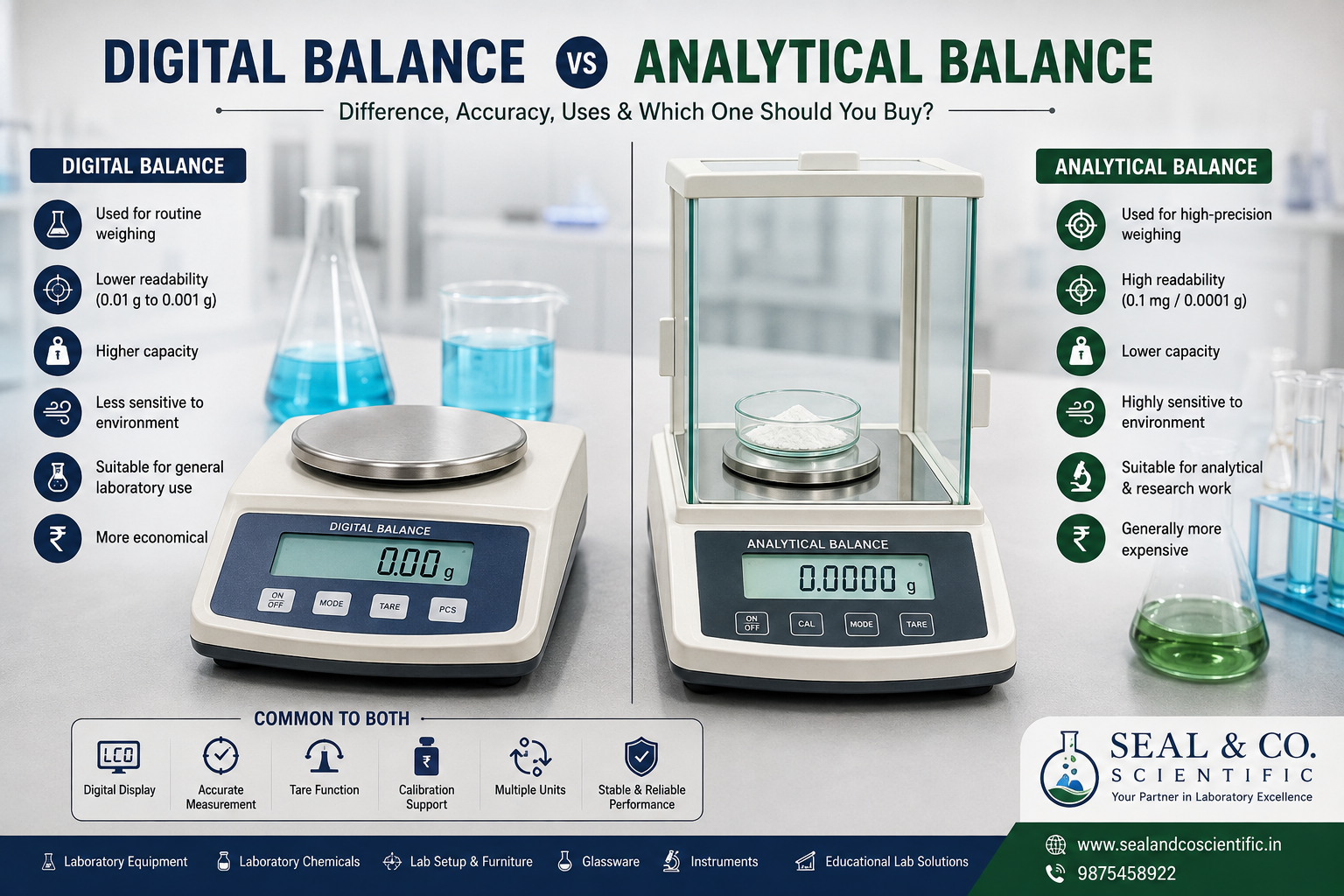
A digital balance is an electronic weighing instrument used to measure the mass of laboratory samples, chemicals, materials, and other objects.
Digital balances are designed primarily for routine weighing applications where extremely high precision is not always required.
Depending on the model, laboratory digital balances can offer different capacities and readability levels. They are commonly used in:
School and college laboratories
Pharmaceutical laboratories
Food testing laboratories
Industrial laboratories
Research laboratories
Quality-control laboratories
General-purpose laboratory work
Modern digital balances may include:
1. Digital LCD/LED display
2. Tare function
3. Zero adjustment
4. Calibration function
5. Overload protection
6. Multiple weighing units
7. Counting function
8. Percentage weighing
9. Battery or mains operation
Digital balances are generally easier to operate and can be suitable for everyday laboratory weighing.
An analytical balance is a high-precision laboratory weighing instrument designed to measure very small differences in mass.
Analytical balances generally provide much finer readability than standard digital balances. Many laboratory analytical balances provide readability of 0.1 mg (0.0001 g), although specifications vary between models.
Because they are highly sensitive to environmental conditions, analytical balances commonly have a draft shield or weighing chamber around the weighing pan.
Analytical balances are frequently used for:
1. Preparation of standard solutions
2. Quantitative chemical analysis
3. Research laboratories
4. Pharmaceutical analysis
5. Sample preparation
6. Quality-control testing
7. Precise formulation work
The main difference between a digital balance and an analytical balance lies in their precision, readability, sensitivity, capacity, and intended application. Although both instruments are used for measuring mass, they are designed for different laboratory requirements.
1. Difference in Precision and Readability
A digital balance is generally designed for routine weighing and may offer different levels of readability depending on the model. An analytical balance is designed for much more precise measurements and commonly provides a readability of 0.1 mg (0.0001 g). Therefore, analytical balances are preferred when very small differences in mass need to be measured.
2. Difference in Sensitivity
Analytical balances are significantly more sensitive than standard digital balances. They can detect very small changes in mass, making them suitable for quantitative analysis, preparation of standard solutions, and research applications. Digital balances are generally better suited for routine weighing where extremely high sensitivity is not required.
3. Difference in Draft Protection
Most analytical balances are equipped with a draft shield or enclosed weighing chamber. This protects the weighing area from air currents that can affect very small measurements. General-purpose digital balances usually do not require the same level of protection because they are less sensitive to minor environmental disturbances.
4. Difference in Capacity
Digital balances are available in a wide range of capacities and can often handle larger samples. Analytical balances generally have a more limited weighing capacity because they are optimized for high-precision measurements rather than heavy loads.
5. Difference in Applications
Digital balances are commonly used for routine weighing in school laboratories, colleges, industrial laboratories, quality-control laboratories, and general laboratory applications.
Analytical balances are more commonly used in analytical chemistry, pharmaceutical laboratories, research and development, quantitative analysis, and precise sample preparation, where accurate mass measurement is critical.
6. Difference in Environmental Sensitivity
An analytical balance is highly sensitive to environmental factors such as air movement, vibration, temperature fluctuations, static electricity, and unstable surfaces. Therefore, it should be installed in a carefully selected location.
A general-purpose digital balance is usually less sensitive and can be more convenient for everyday laboratory use.
7. Difference in Cost
Analytical balances generally cost more than standard digital balances because they incorporate higher-precision weighing technology and additional features such as draft protection and advanced calibration systems.
Digital balances are usually a more economical option for laboratories that primarily require routine weighing.
8. Difference in Operating Requirements
Digital balances are generally simple to operate and are suitable for frequent routine measurements. Analytical balances require more careful handling. Users need to minimize environmental disturbances, allow the reading to stabilize, use appropriate weighing containers, and follow proper calibration and operating procedures.
In Simple Words
Think of it this way:
Digital Balance = Routine + Practical + Higher Capacity
Analytical Balance = High Precision + High Sensitivity + Analytical Applications
So, if your laboratory mainly needs to weigh chemicals and samples for routine experiments, a suitable digital balance may be sufficient. If you need to measure very small quantities accurately for analytical or research work, an analytical balance is the better choice.
Accuracy vs Readability: What's the Difference?
One common mistake when selecting a laboratory balance is treating readability and accuracy as the same thing.
They are not.
Readability
Readability refers to the smallest increment that the balance display can show.
For example, a balance with a readability of:
0.001 g
can display measurements in increments of 0.001 gram.
An analytical balance with:
0.0001 g
readability can display much smaller increments.
Accuracy
Accuracy refers to how close the measured value is to the true value.
A balance can have very fine readability but still require proper calibration and controlled operating conditions to achieve reliable results.
Therefore, when purchasing a laboratory balance, do not look at readability alone. Also consider:
Repeatability
Linearity
Calibration
Minimum sample weight
Environmental conditions
Temperature stability
Manufacturer specifications
Analytical balances are extremely sensitive.
Small environmental disturbances can affect the measurement, including:
Air movement
Drafts
Temperature changes
Vibrations
Static electricity
Physical contact
Uneven surfaces
For this reason, analytical balances are commonly equipped with a transparent weighing chamber.
The draft shield helps reduce the influence of air movement around the weighing pan and improves measurement stability.
This is particularly important when weighing very small quantities.
A digital balance is generally appropriate when you need routine and reasonably precise weighing rather than very high analytical precision.
For example, a school chemistry laboratory may use a digital balance to weigh:
Chemicals for routine experiments
Soil samples
Educational materials
Laboratory materials
General-purpose samples
Digital balances are also useful when the required weighing capacity is higher than what a typical analytical balance can provide.
Simple operation
Easy-to-read display
Suitable for routine work
Generally more affordable
Available in different capacities
Useful for schools and general laboratories
An analytical balance should be considered when the laboratory requires highly precise mass measurements.
For example, it can be used when preparing a standard solution where a small difference in the mass of a chemical can significantly affect the final concentration.
Typical applications include:
Analytical chemistry
Research and development
Pharmaceutical analysis
Standard solution preparation
Precise sample preparation
Quantitative laboratory procedures
Very fine readability
High sensitivity
Suitable for analytical applications
Improved protection against drafts
Designed for precise laboratory measurements
For many school laboratories, an ordinary digital laboratory balance may be sufficient for routine experiments.
Schools should consider an analytical balance when the curriculum or laboratory activities specifically require very precise mass measurements.
When selecting a balance for a school laboratory, consider:
1. Required weighing capacity
2. Required readability
3. Frequency of useType of experiments
4. Budget
5. Availability of calibration and service support
For a new school laboratory, the balance should be selected according to the actual experiments students will perform rather than simply choosing the most expensive instrument.
Research laboratories often require both types of balances.
A digital balance can be used for routine weighing and larger samples, while an analytical balance can be reserved for applications requiring higher precision.
For example:
Digital Balance → Routine sample weighing
Analytical Balance → Precise chemical weighing and standard preparation
Using the appropriate balance for each task can improve efficiency and reduce unnecessary wear on high-precision instruments.
Before purchasing a laboratory balance, consider the following specifications.
1. Capacity
Capacity indicates the maximum mass the balance can weigh.
Choose a capacity suitable for your normal sample sizes without regularly approaching the maximum limit.
2. Readability
Determine the smallest mass difference you actually need to measure.
For routine weighing, a lower level of precision may be sufficient. Analytical applications may require much finer readability.
3. Repeatability
Repeatability indicates how consistently the balance produces the same result when the same sample is weighed repeatedly under the same conditions.
4. Calibration
Check whether the balance supports internal or external calibration and understand the calibration requirements specified by the manufacturer.
5. Environmental Conditions
For analytical balances, consider the location carefully.
Avoid placing the balance near:
Windows
Fans
Air conditioners
Doors
Vibrating equipment
High-traffic areas
6. Service and Support
For professional laboratory use, after-sales service and calibration support can be just as important as the initial purchase price.
How to Get Better Results from a Laboratory Balance
Regardless of whether you use a digital or analytical balance, proper operating practices are important.
Follow these basic practices:
Place the balance on a stable, level surface.
Keep the weighing area clean.
Allow the balance to stabilize before use.Use suitable weighing containers.
Use the tare function correctly.
Avoid touching samples or containers unnecessarily.
Keep the balance away from drafts and vibration.
Follow the manufacturer's calibration instructions.
Do not exceed the specified capacity.
Keep the balance protected when not in use.
For analytical balances, environmental control is particularly important.
Choose a Digital Balance if:
You need routine weighing.
You need a higher weighing capacity.
Extremely fine measurements are not required.
The balance will be used frequently for general laboratory work.
You want a practical solution for school or general laboratory applications.
Choose an Analytical Balance if:
You need very fine readability.
You are preparing standard solutions.
You perform quantitative analytical work.
Your laboratory requires highly precise mass measurements.
You need better protection against environmental disturbances.
Is an analytical balance a digital balance?
Yes. Modern analytical balances are electronic and normally display measurements digitally. However, an analytical balance is specifically designed for much higher precision than a typical general-purpose digital balance.
Is a digital balance accurate?
Yes, digital balances can provide reliable measurements when they are properly selected, calibrated, installed, and operated. The required level of accuracy depends on the application.
Which is more accurate: digital balance or analytical balance?
A typical analytical balance provides much finer readability and is designed for higher-precision applications. However, actual performance depends on the specific model and its specifications.
Can I use an analytical balance for routine weighing?
Yes, but it may not always be practical. If high precision is unnecessary, a suitable digital balance can perform routine weighing more efficiently.
What is the common readability of an analytical balance?
Many analytical balances have a readability of 0.1 mg (0.0001 g), but specifications vary by model.
Does an analytical balance need calibration?
Yes. Analytical balances should be calibrated according to the manufacturer's instructions and the laboratory's quality requirements.
Conclusion
The choice between a digital balance vs analytical balance depends primarily on the required precision, capacity, application, and laboratory environment.
A digital balance is generally a practical choice for routine laboratory weighing, while an analytical balance is designed for applications requiring much finer mass measurements.
For schools, colleges, research laboratories, pharmaceutical laboratories, and industrial laboratories, selecting the right balance should always begin with the measurement requirements of the application.
If you are setting up or upgrading a laboratory, consider the balance's capacity, readability, repeatability, calibration requirements, environmental sensitivity, and after-sales support before making a purchase.
Looking for laboratory weighing equipment for a school, college, research laboratory, pharmaceutical laboratory, or industrial laboratory?
SEAL AND CO. SCIENTIFIC provides laboratory equipment and laboratory setup solutions for different educational and professional requirements.
Explore our laboratory equipment range or contact us to discuss your laboratory requirements.