If you've ever purchased chemicals for a laboratory, you've probably come across the terms laboratory chemicals and reagents. Although they are often used interchangeably, they do not always mean the same thing.
Understanding the difference helps schools, colleges, research laboratories, hospitals, and industrial facilities purchase the right products for their applications.
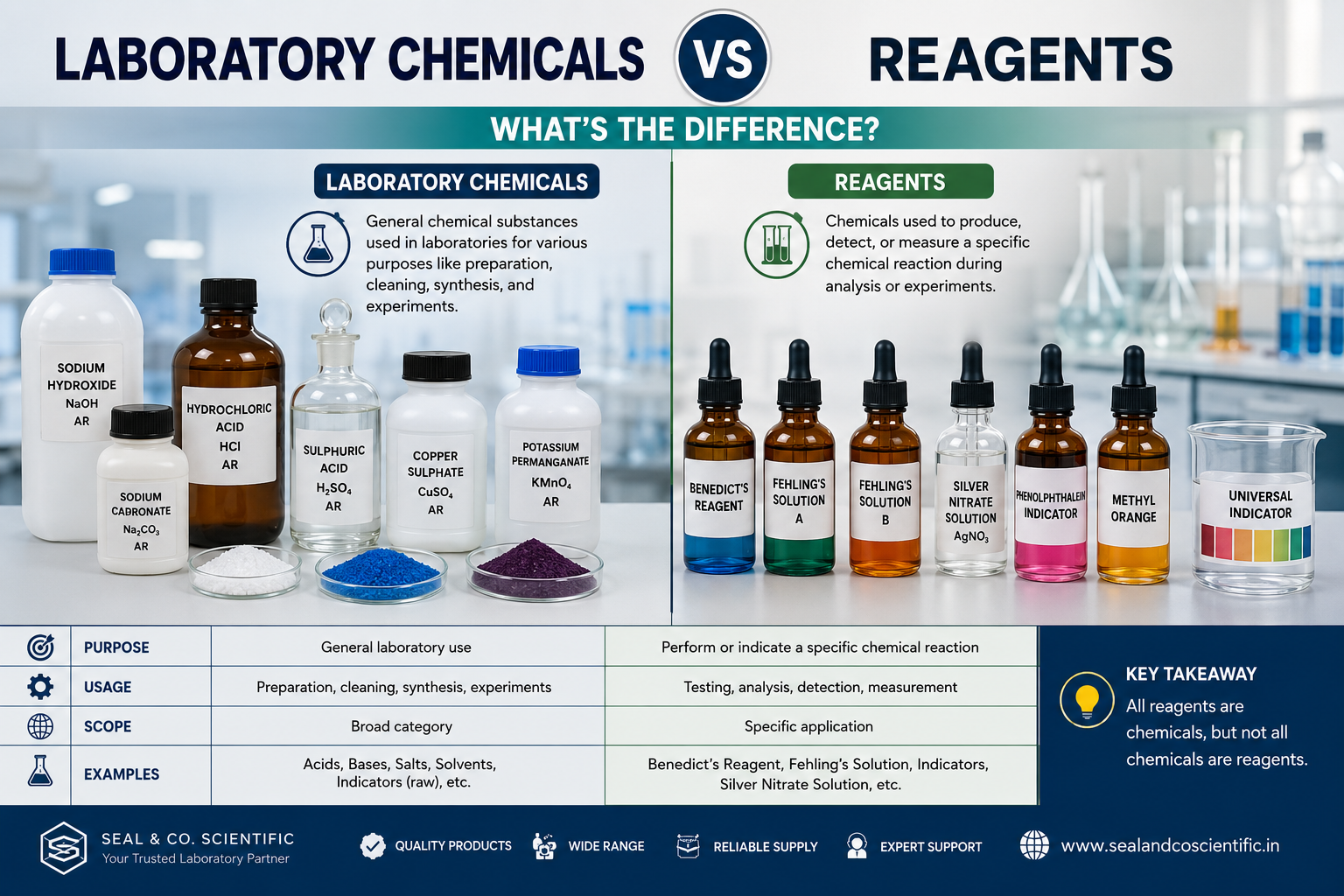
Laboratory chemicals are any chemical substances used in laboratories for experiments, analysis, manufacturing, cleaning, calibration, or research.
They include acids, bases, salts, solvents, indicators, and many other compounds used in educational, analytical, and industrial laboratories.
These chemicals are used in chemistry practicals, quality control laboratories, pharmaceutical industries, food testing laboratories, and research institutions.
A reagent is a chemical substance specifically used to produce, detect, or measure a chemical reaction.
In simple terms, every reagent is a laboratory chemical, but not every laboratory chemical is used as a reagent.
Reagents are selected because they serve a particular analytical or experimental purpose.
These reagents are widely used in chemical analysis, biological testing, diagnostic laboratories, and educational experiments.
Why Does the Difference Matter?
Choosing the correct product ensures accurate results and safe laboratory practices.
For example:
A school chemistry laboratory may purchase Hydrochloric Acid as a laboratory chemical for several experiments.
The same laboratory may also require Phenolphthalein as a reagent for acid-base titration.
Understanding this distinction helps laboratories avoid purchasing the wrong materials.
Which One Should Schools Buy?
Most educational laboratories require both laboratory chemicals and reagents.
Purchasing from a trusted laboratory supplier ensures product quality, proper labeling, and reliable documentation.
When selecting laboratory chemicals or reagents, consider:
1. Product purity and grade
2. Proper packaging and labeling
3. Certificate of Analysis (where applicable)
4. Reliable stock availability
5. Technical support
6. Safe transportation and storage
A dependable supplier can help educational institutions maintain safe and effective laboratory operations.
Frequently Asked Questions (FAQs)
Are laboratory chemicals and reagents the same?
Not exactly. Laboratory chemicals include all chemicals used in laboratories, while reagents are chemicals specifically intended to produce, detect, or measure chemical reactions.
Can one chemical be both a laboratory chemical and a reagent?
Yes. For example, Hydrochloric Acid is a laboratory chemical and can also function as a reagent in many analytical procedures.
Do schools need reagents?
Yes. School laboratories commonly use reagents such as indicators and prepared solutions for chemistry practicals.
What is the difference between chemicals and reagents in simple words?
A laboratory chemical is any chemical used in a laboratory. A reagent is a chemical used for a specific experimental or analytical purpose.
Conclusion
Laboratory chemicals and reagents are closely related, but they are not identical. Laboratory chemicals form the broader category, while reagents are specialized chemicals designed for specific analytical or experimental functions.
Whether you are setting up a school laboratory, purchasing supplies for a college, or managing an industrial testing facility, understanding this difference will help you choose the right products and improve the accuracy of your laboratory work.