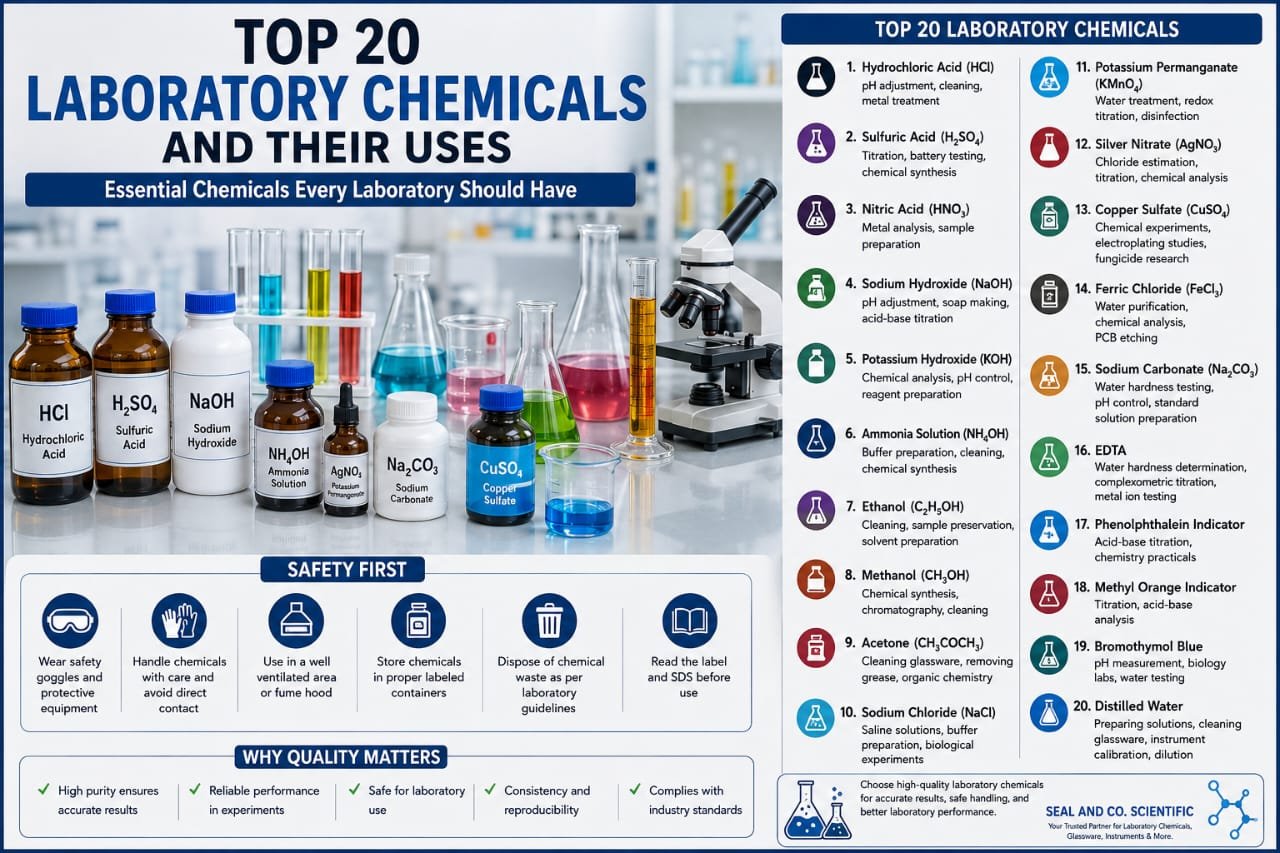
Laboratory chemicals play a vital role in scientific research, education, water testing, pharmaceuticals, healthcare, food analysis, and industrial quality control. From preparing solutions to performing chemical reactions and analytical testing, every laboratory relies on high-quality chemicals to produce accurate and reliable results.
Whether you're setting up a school laboratory, a college chemistry lab, a diagnostic laboratory, or an industrial testing facility, understanding the uses of common laboratory chemicals is essential.
In this guide, we'll explore the top 20 laboratory chemicals, their chemical formulas, common applications, and important safety precautions.
Chemical Formula: HCl
Hydrochloric acid is one of the most widely used laboratory acids. It is a strong, colorless acid used for chemical analysis, pH adjustment, and cleaning laboratory glassware.
Common Uses
pH adjustment
Chemical analysis
Water testing
Cleaning laboratory equipment
Metal treatment
Safety
Wear gloves and safety goggles.
Avoid inhaling fumes.
Store in acid-resistant containers.
Sulfuric acid is a highly corrosive mineral acid widely used in analytical chemistry and industrial laboratories.
Common Uses
Acid-base titration
Battery testing
Chemical synthesis
Laboratory analysis
Safety
Always add acid to water.
Wear protective clothing.
Store in a cool, dry place.
Nitric acid is a powerful oxidizing acid commonly used in analytical laboratories.
Common Uses
Metal analysis
Chemical digestion
Laboratory research
Sample preparation
Safety
Highly corrosive.
Use inside a fume hood.
Avoid contact with skin.
Also known as caustic soda, sodium hydroxide is a strong alkali used in laboratories and industries.
Common Uses
pH adjustment
Water treatment
Soap making
Acid-base titration
Safety
Causes severe burns.
Wear gloves and eye protection.
Store in airtight containers.
Potassium hydroxide is another strong alkali frequently used in analytical laboratories.
Common Uses
Chemical analysis
Biodiesel production
pH control
Laboratory reagent preparation
Ammonia solution is commonly used in qualitative chemical analysis.
Common Uses
Buffer preparation
Cleaning laboratory glassware
Chemical synthesis
Analytical chemistry
Ethanol is one of the most versatile laboratory solvents.
Cleaning laboratory equipment
Sample preservation
Biological laboratories
Solvent preparation
Methanol is an important solvent used in chemical laboratories.
Common Uses
Chemical synthesis
Chromatography
Laboratory cleaning
Fuel research
Acetone is a fast-evaporating organic solvent.
Common Uses
Preparing saline solutions
Buffer preparation
Biological experiments
Water testing
Potassium permanganate is a strong oxidizing agent.
Common Uses
Water treatment
Redox titration
Disinfection
Chemical analysis
Silver nitrate is widely used in analytical chemistry.
Common Uses
Chloride estimation
Titration
Chemical analysis
Research laboratories
Copper sulfate is commonly used in educational and industrial laboratories.
Common Uses
Common Uses
Chemical experiments
Fungicide research
Electroplating studies
Laboratory demonstrations
Ferric chloride is widely used in water treatment and laboratory testing.
Common Uses
Water purification
Chemical analysis
PCB etching
Research
Also called washing soda, sodium carbonate is an important laboratory reagent.
Common Uses
Water hardness testing
pH control
Standard solution preparation
Glass manufacturing research
EDTA is a chelating agent used in analytical chemistry.
Common Uses
Water hardness determination
Complexometric titration
Laboratory analysis
Metal ion testing
Phenolphthalein is a commonly used acid-base indicator.
Common Uses
Acid-base titration
Chemistry practicals
Laboratory analysis
Educational experiments
Methyl orange changes color depending on the pH of the solution.
Common Uses
Titration
Acid-base analysis
Laboratory teaching
This indicator is widely used for measuring pH changes.
Common Uses
Biology laboratories
Chemistry practicals
Water quality testing
Educational demonstrations
Although not a chemical reagent, distilled water is one of the most important laboratory consumables.
Common Uses
Preparing solutions
Cleaning laboratory glassware
Instrument calibration
Chemical dilution
Safety Tips for Handling Laboratory Chemicals
Always follow these safety practices:
Read the chemical label before use.
Wear laboratory coats, gloves, and safety goggles.
Never mix chemicals without proper instructions.
Store acids and alkalis separately.
Label every chemical container.
Keep chemicals away from direct sunlight.
Dispose of chemical waste according to laboratory guidelines.
Wash your hands after handling chemicals.
Proper chemical handling protects both laboratory personnel and experimental accuracy.
How to Choose High-Quality Laboratory Chemicals
When purchasing laboratory chemicals, consider:
Chemical purity (AR, LR, or HPLC grade)Manufacturer reputation
Proper labeling
Expiry date
Batch number
Storage recommendations
Safety Data Sheet (SDS) availability
Using certified, high-quality chemicals ensures reliable and reproducible results.
Conclusion
Laboratory chemicals are the backbone of scientific research, education, quality control, and industrial testing. Understanding their properties, applications, and safety precautions helps laboratories maintain accuracy, efficiency, and safety
Whether you operate a school laboratory, research institute, diagnostic laboratory, water testing facility, pharmaceutical company, or industrial laboratory, choosing the right chemicals is essential for successful experiments.
Frequently Asked Questions (FAQs)
What are laboratory chemicals?
Laboratory chemicals are substances used for scientific experiments, testing, research, analysis, education, and industrial quality control.
Which laboratory chemical is used most frequently?
Hydrochloric acid, sulfuric acid, sodium hydroxide, ethanol, and distilled water are among the most commonly used laboratory chemicals.
What is the difference between AR Grade and LR Grade chemicals?
AR (Analytical Reagent) Grade chemicals have very high purity and are used for analytical work. LR (Laboratory Reagent) Grade chemicals are suitable for routine laboratory experiments where ultra-high purity is not essential.
Why is chemical purity important?
High-purity chemicals improve the accuracy, reliability, and reproducibility of laboratory results.
Where can I buy quality laboratory chemicals in India?