
Pipettes are among the most commonly used liquid-handling instruments in laboratories. They are used to measure, transfer, and dispense liquids during experiments, sample preparation, testing, and research.
However, the terms “pipette” and “micropipette” are often used interchangeably, even though they can refer to different types of laboratory instruments.
So, what is the difference between a micropipette and a pipette?
In simple terms, a micropipette is designed primarily for handling very small liquid volumes, usually in microlitres (µL), while the term pipette is broader and can refer to several instruments designed to measure and transfer liquids across different volume ranges.
In this guide, we will explain the difference between micropipettes and pipettes, their working principles, types, applications, advantages, and how to choose the right instrument for your laboratory.
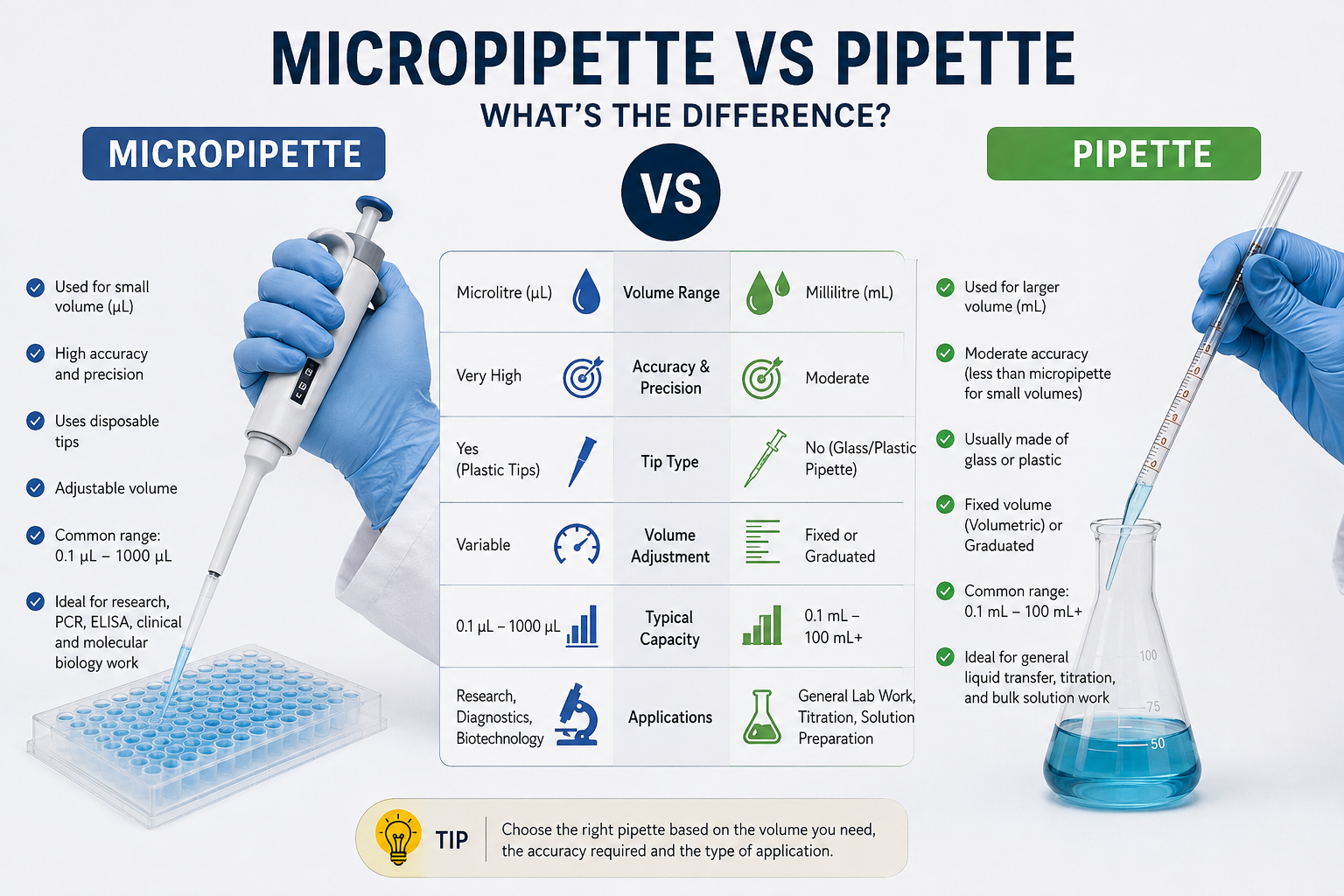
A pipette is a laboratory instrument used to accurately measure and transfer a specific quantity of liquid from one container to another.
Pipettes are available in many different designs and volume capacities. Depending on the type, they may be made from glass or plastic and can be operated manually or mechanically.
Pipettes are widely used in:
Chemistry laboratories
Microbiology laboratories
Clinical laboratories
Pharmaceutical laboratories
Biotechnology laboratories
Research laboratories
School and college laboratories
Examples include graduated pipettes, volumetric pipettes, serological pipettes, transfer pipettes, and micropipettes.
Therefore, “pipette” is a broad term rather than the name of only one specific instrument.
A micropipette is a type of precision pipette specifically designed to measure and transfer very small volumes of liquid, generally in the microlitre (µL) range.
Most modern laboratory micropipettes are adjustable and use disposable plastic tips.
Common micropipette volume ranges include:
P2: approximately 0.2–2 µL
P10: approximately 0.5–10 µL
P20: approximately 2–20 µL
P100: approximately 10–100 µL
P200: approximately 20–200 µL
P1000: approximately 100–1000 µL
Exact volume ranges vary according to the manufacturer and model.
Micropipettes are particularly important in applications where even a small volume difference can affect the final result.
The easiest way to understand the difference is to think of micropipette as a specialized type of pipette.
A conventional laboratory pipette may be designed for measuring and transferring millilitre-level volumes, depending on its type.
A micropipette, on the other hand, is designed specifically for accurate small-volume liquid handling, often from less than one microlitre to around one millilitre depending on the model.
The exact distinction depends on the type of pipette being compared.
Volume Range
One of the most important differences is the volume range.
Traditional pipettes such as graduated or volumetric pipettes are commonly used for volumes measured in millilitres (mL).
Micropipettes are primarily designed for volumes measured in microlitres (µL).
For example:
1 mL = 1,000 µL
Therefore, when a laboratory procedure requires the transfer of 20 µL, a micropipette is generally more appropriate than a conventional graduated pipette.
For larger volumes, a suitable graduated, volumetric, or serological pipette may be more practical.
Accuracy and Precision
Both pipettes and micropipettes can provide accurate liquid transfer when the appropriate instrument and technique are used.
However, micropipettes are specifically engineered for precise small-volume measurements.
For example, transferring a few microlitres of a DNA sample, enzyme solution, or PCR reagent requires an instrument designed for very small volumes.
Using an inappropriate pipette for such applications can introduce significant relative volume errors.
Accuracy also depends on:
Pipette quality
Calibration
Pipette tips
Liquid properties
Temperature
Pipetting technique
Maintenance
User experience
Therefore, simply using a micropipette does not guarantee accurate results. Proper technique and calibration are equally important.
The working principle depends on the type of pipette.
For example, a graduated pipette uses calibrated markings to measure different liquid volumes.
A volumetric pipette is designed to deliver one specific volume with high accuracy.
A mechanical micropipette generally uses piston displacement and air displacement to aspirate and dispense liquid.
In an air-displacement micropipette, movement of the piston changes the volume of air inside the pipette. This creates a pressure difference that allows liquid to enter the attached disposable tip.
The basic process is:
Piston movement → Pressure change → Liquid aspiration → Liquid dispensing
Other micropipette technologies, such as positive-displacement systems, operate differently and may be better suited to certain challenging liquids.
Types of Pipettes
The term pipette covers many different laboratory instruments.
A graduated pipette contains calibration markings along its length.
It allows users to measure and transfer different volumes within its specified capacity.
Graduated pipettes are commonly used in general laboratory applications where multiple volumes may be required.
A volumetric pipette is designed to measure and deliver one specific volume accurately.
It usually has a bulb-shaped central section and a calibration mark indicating the intended volume.
Volumetric pipettes are commonly used when accurate preparation of standard solutions is required.
Serological pipettes are commonly used for transferring relatively larger liquid volumes, particularly in biological and cell culture applications.
They are often used with a pipette controller or pipette aid.
Transfer pipettes are generally simple plastic pipettes designed for transferring liquids rather than highly precise quantitative measurement.
They can be useful for routine laboratory procedures where high precision is not required.
A micropipette is designed for accurate small-volume liquid handling.
It may be:
Single-channel
Multichannel
Fixed-volume
Variable-volume
Air displacement
Positive displacement
Types of Micropipettes
Micropipettes can also be classified into different categories.
A single-channel micropipette transfers liquid through one tip at a time.
It is suitable for individual samples and general laboratory work.
A multichannel micropipette can transfer liquid through several channels simultaneously.
It is particularly useful for microplate applications such as ELISA, PCR preparation, and high-throughput laboratory workflows.
A fixed-volume micropipette is designed to dispense one predetermined volume.
It can be useful when the same volume is repeatedly required.
A variable-volume micropipette allows the user to select a volume within a specified range.
For example, a 20–200 µL micropipette can be adjusted for different volumes within its operating range.
Another major difference can be seen in the way liquid contacts the instrument.
Modern micropipettes generally use disposable plastic tips.
The liquid enters the tip rather than the main body of the micropipette.
This design helps reduce contamination and allows the same micropipette to be used for different samples by replacing the tip.
Many traditional glass pipettes, however, are designed differently and may require cleaning and sterilization between uses.
Disposable pipettes are also available for many laboratory applications.
The choice depends on the type of pipette, application, contamination risk, and laboratory protocol.
The best instrument depends largely on the required volume and application.
Micropipettes are commonly used in:
Molecular biology
PCR
DNA and RNA work
Microbiology
Biotechnology
Clinical diagnostics
Pharmaceutical research
Cell biology
ELISA and microplate assays
Serial dilution
Other types of pipettes are commonly used for:
Solution preparation
Chemical analysis
Titration-related procedures
Transferring millilitre quantities
Cell culture
General laboratory liquid handling
Preparing standards and reagents
There is no single pipette that is ideal for every laboratory application.
Neither is universally “better.”
The correct choice depends on the volume, application, required accuracy, liquid properties, and laboratory procedure.
If you need to transfer a very small volume such as 10 µL, a suitable micropipette would generally be the appropriate choice.
If you need to transfer 10 mL of solution, a suitable larger-volume pipette may be more practical.
The goal is not to select the most sophisticated instrument, but to select the right instrument for the required volume and application.
Before purchasing a pipette or micropipette, consider the following factors.
1. Required Volume
Determine the typical volumes you will handle.
For very small volumes, consider a micropipette with an appropriate range.
For larger volumes, consider graduated, volumetric, serological, or other suitable pipettes.
2. Accuracy and Precision
Check the manufacturer's specifications for accuracy and precision at the required volume.
For critical laboratory procedures, calibration and verification should also be considered.
3. Type of Liquid
Liquid properties can influence pipetting performance.
Viscous, volatile, foaming, or high-density liquids may require specialized pipetting techniques or equipment.
4. Single or Multichannel Operation
For individual samples, a single-channel micropipette may be sufficient.
For microplate-based work, a multichannel micropipette can improve efficiency.
5. Tip Compatibility
For micropipettes, make sure compatible tips are readily available.
A poorly fitting tip can cause leakage and inconsistent results.
6. Ergonomics
If pipetting is performed frequently, an ergonomic design can help reduce hand fatigue and improve user comfort.
7. Calibration and Service
Choose laboratory equipment that can be properly calibrated and serviced when required.
Regular calibration is particularly important when accurate quantitative results are essential.
Common Pipetting Mistakes
Regardless of whether you are using a pipette or micropipette, poor technique can affect results.
Selecting an inappropriate volume range
Using incompatible tips
Aspirating liquid too quickly
Dispensing too quickly
Holding the instrument incorrectly
Immersing the tip too deeply
Creating air bubbles
Reusing disposable tips unnecessarily
Ignoring calibration
Failing to clean contaminated equipment
Proper training and consistent technique are essential for reliable liquid handling.
Suppose a laboratory procedure requires transferring 25 µL of reagent into a reaction tube.
A suitable micropipette, such as a model covering the 20–200 µL range, would generally be appropriate.
Now suppose the laboratory needs to transfer 10 mL of buffer solution.
A larger-volume pipette designed for millilitre-scale liquid handling would generally be more suitable.
This example demonstrates an important principle:
Choose the pipette according to the required volume and application—not simply according to the name of the instrument.
Frequently Asked Questions
Is a micropipette a type of pipette?
Yes. Micropipettes are specialized pipetting instruments designed primarily for accurately handling very small liquid volumes.
What is the main difference between a pipette and a micropipette?
The main difference is generally the volume range and application. Micropipettes are designed for small volumes, typically in microlitres, while other pipettes may be designed for larger volumes or specific applications.
Is a micropipette more accurate than a pipette?
Not necessarily in every situation. Accuracy depends on the instrument's design, volume range, calibration, technique, and application. A micropipette is specifically designed to provide accurate small-volume dispensing.
Can a micropipette measure millilitres?
Some micropipettes can handle volumes approaching or exceeding 1 mL, depending on the model. However, for larger volumes, another type of pipette may be more appropriate.
Why are disposable tips used with micropipettes?
Disposable tips help reduce cross-contamination and allow the pipette body to be reused while using a fresh liquid-contact surface for each sample.
How often should a micropipette be calibrated?
Calibration frequency depends on the manufacturer's recommendations, laboratory quality requirements, frequency of use, and applicable standards or procedures.
Conclusion
The difference between a micropipette and a pipette is primarily related to their design, volume range, and intended application.
A micropipette is a specialized precision instrument for handling very small volumes, typically in microlitres. Other types of pipettes—including graduated, volumetric, and serological pipettes—are designed for different volume ranges and laboratory applications.
For reliable results, laboratories should select equipment based on the required volume, accuracy, liquid properties, application, and operating procedure.
Whether you are setting up a school science laboratory, microbiology laboratory, research facility, diagnostic laboratory, or pharmaceutical laboratory, choosing the right liquid-handling equipment can make laboratory work more accurate, efficient, and consistent.