
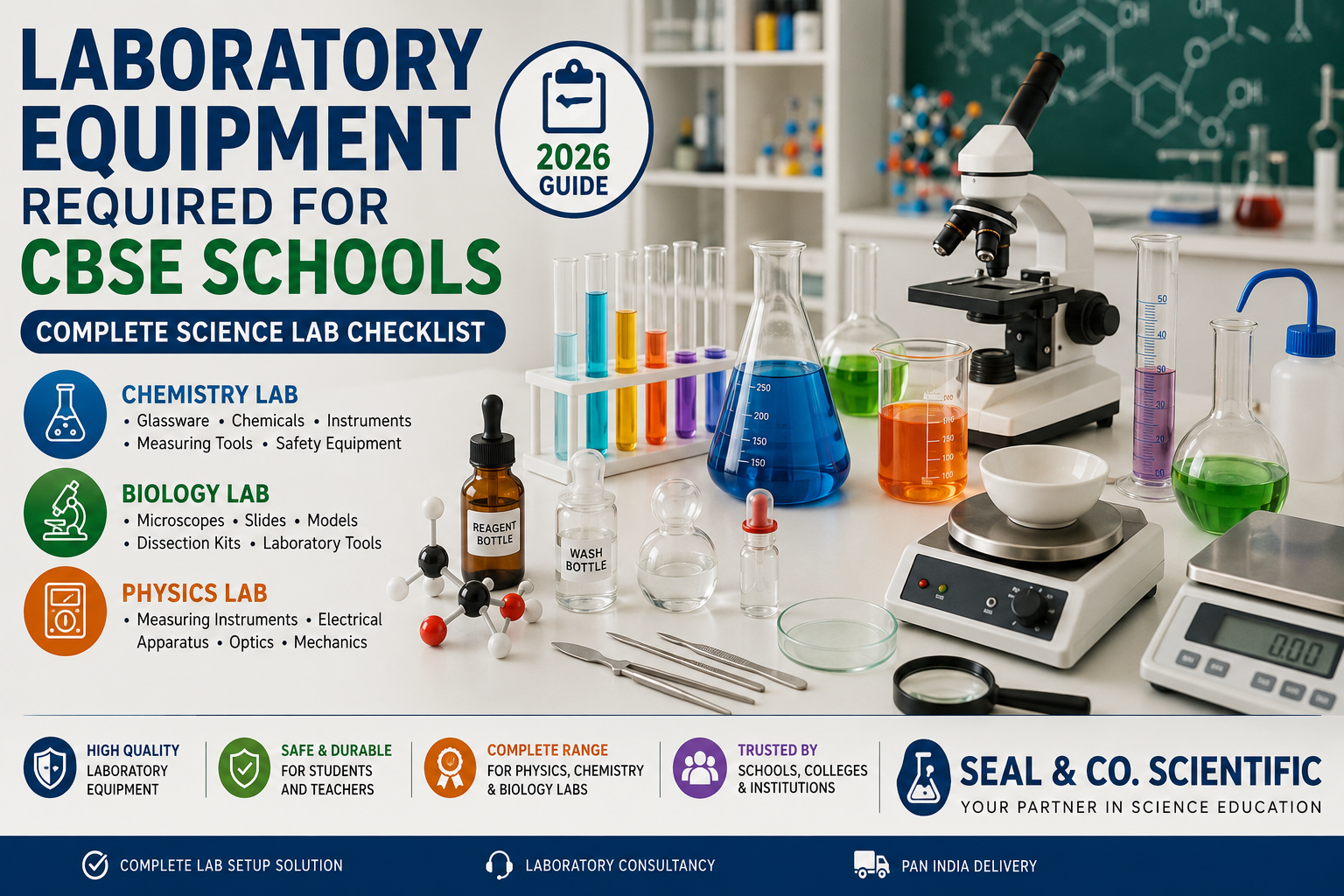
A well-equipped science laboratory is one of the most important requirements for every CBSE-affiliated school. Practical learning helps students understand scientific concepts through observation, experimentation, and analysis. Whether you're establishing a new laboratory or upgrading an existing one, selecting the right laboratory equipment is essential for effective science education.
In this guide, we provide a comprehensive list of laboratory equipment required for CBSE schools, covering Physics, Chemistry, and Biology laboratories along with important safety equipment.
Why Are Well-Equipped Laboratories Important?
A modern science laboratory helps students:
1.Perform experiments safely.
2.Improve practical nowledge
3.Develop analytical thinking
4.Build scientific curiosity
5.Meet CBSE practical requirements
6.Prepare for competitive examinations
Proper laboratory infrastructure also enhances the overall academic reputation of the school.
Chemistry laboratories require high-quality glassware, measuring instruments, and chemicals for practical experiments.
Schools should maintain commonly used analytical-grade chemicals, acids, alkalis, salts, and indicators according to the CBSE practical syllabus.
Examples include:
All chemicals should be stored safely with proper labels.
Physics laboratories require precision instruments for measurement and experimentation.
Essential equipment includes:
1.Vernier Calipers
2.Screw Gauge
3.Meter Scale
4.Measuring Tape
5.Spring Balance
6.Stop Clock
7.Pendulum Bob
8.Resistance Box
9.Galvanometer
10.Ammeter
11.Voltmeter
12.Rheostat
13.Optical Bench
14.Prism
15.Convex Lens
16.Concave Lens
17.Magnets
18.Bar Magnet
19.Compass
20.Transformer Models
21.Electrical Circuit Kits
Biology laboratories should provide students with opportunities to study living organisms, plant tissues, and human anatomy.
Important equipment includes:
1.Compound Microscope
2.Stereo Microscope
3.Prepared Slides
4.Blank Slides
5.Cover Slips
6.Dissecting Kit
7.Forceps
8.Scalpels
9.Specimen Bottles
10.Petri Dishes
11.Pipettes
12.Glass Droppers
13.Biological Models
14.Human Skeleton Model
15.Human Torso Model
16.Plant Cell Model
17.Animal Cell Model
18.Charts and Educational Posters
Proper laboratory furniture improves safety and organization.
Recommended furniture:
1.Laboratory Work Tables
2.Chemical Storage Cabinets
3.Reagent Racks
4.Sink Units
5.Fume Hood (recommended for senior secondary labs)
6.Teacher Demonstration Table
7.Laboratory Stools
8.Storage Cupboards
9.Glassware Cabinets
Every CBSE school laboratory should have appropriate safety equipment.
Safety essentials include:
1.Fire Extinguishers
2.First Aid Box
3.Safety Goggles
4.Laboratory Coats
5.Hand Gloves
6.Eye Wash Bottle
7.Spill Control Kit
8.Fire Blanket
9.Emergency Exit Signage
10.Chemical Waste Containers
Students should also receive proper laboratory safety instructions before practical sessions.
Frequently used consumables include:
Tips for Setting Up a CBSE School Laboratory
SEAL & CO. SCIENTIFIC supplies a wide range of laboratory products for schools, colleges, universities, research institutes, hospitals, diagnostic laboratories, and industrial laboratories.
Our product range includes:
We also provide laboratory consultancy, calibration support, and NABL third-party testing assistance to help institutions maintain quality standards.
If you cannot find a particular product on our website, simply send us your requirement through WhatsApp or email. Our team will help you source the exact laboratory equipment or chemical you need.
Frequently Asked Questions (FAQs)
What laboratory equipment is required for CBSE schools?
CBSE schools generally require separate Physics, Chemistry, and Biology laboratories equipped with glassware, scientific instruments, chemicals, microscopes, electrical apparatus, laboratory furniture, and safety equipment.
Which glassware is most commonly used in school laboratories?
Beakers, conical flasks, measuring cylinders, test tubes, burettes, pipettes, reagent bottles, and volumetric flasks are among the most frequently used items.
Are safety items mandatory in school laboratories?
Yes. Safety equipment such as fire extinguishers, first aid kits, safety goggles, laboratory coats, gloves, and emergency signage are essential for protecting students and staff.
How often should laboratory equipment be inspected?
Laboratory equipment should be inspected regularly, cleaned after use, and calibrated or replaced as needed to ensure safe and accurate practical work.
Conclusion
A well-equipped laboratory is essential for delivering quality science education in CBSE schools. Investing in reliable laboratory equipment, durable glassware, accurate instruments, and proper safety systems helps students gain practical experience while ensuring compliance with educational standards.
Whether you are setting up a new science laboratory or upgrading an existing one, choosing dependable laboratory equipment and trusted suppliers will create a safer, more effective learning environment for every student.

I will send required specific equipments list, send me the price. Or total costs
Thank you for your enquiry. Kindly share the **specific equipment list with required specifications and quantities**. We will provide you with the **individual prices and total estimated cost** accordingly. You can send the list here or contact us directly. We’ll be happy to assist you.