
Sterilization is one of the most critical processes in laboratories, hospitals, pharmaceutical industries, and research facilities. Proper sterilization ensures that instruments and materials are free from microorganisms, reducing the risk of contamination and ensuring reliable experimental results.
Among the most commonly used sterilization equipment are the Autoclave and the Hot Air Oven. Although both are designed to sterilize laboratory items, they operate on different principles and are suitable for different applications.
In this article, we'll compare these two sterilization methods to help you determine which one best suits your laboratory needs.
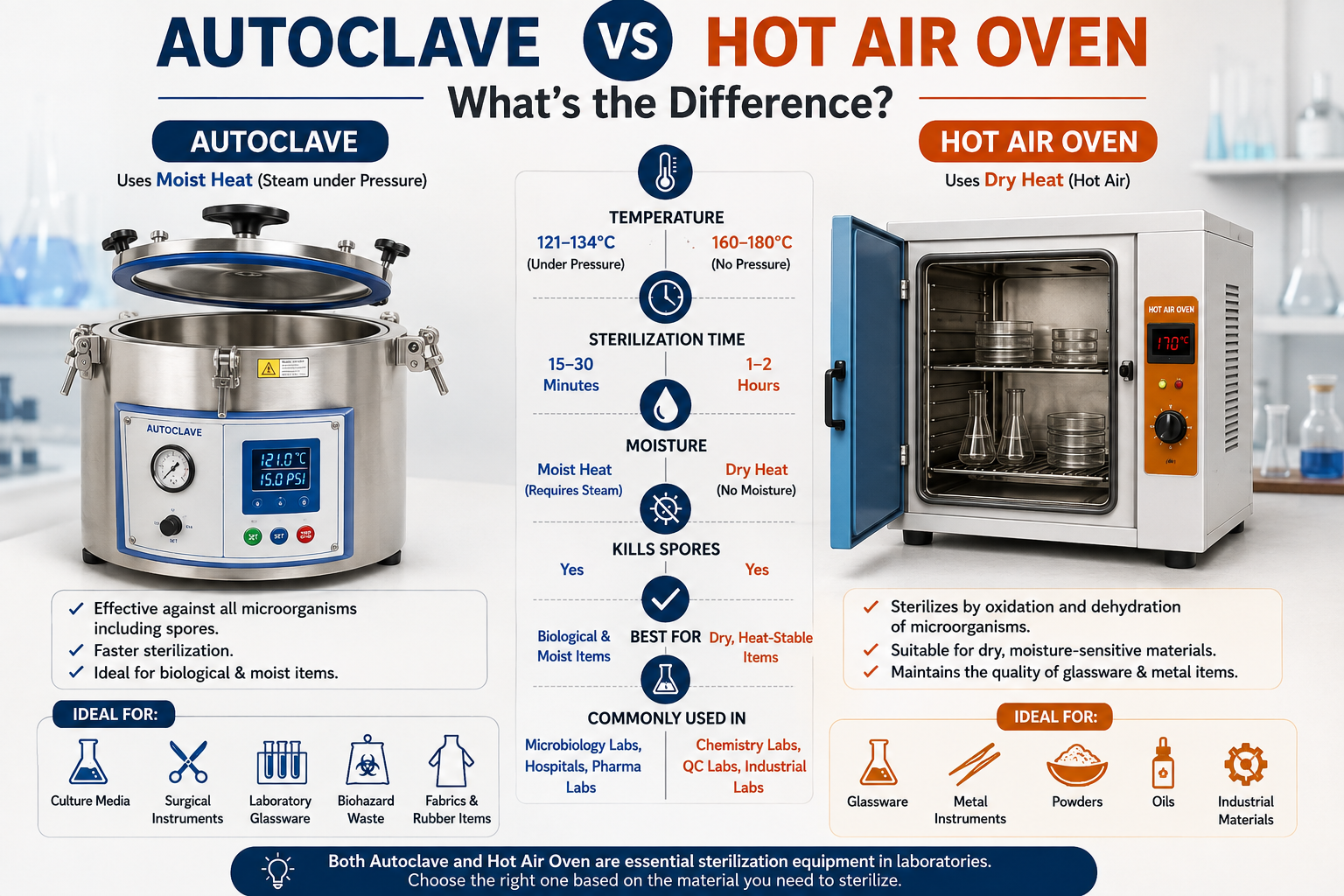
An autoclave is a sterilization device that uses pressurized steam (moist heat) to destroy bacteria, viruses, fungi, and even highly resistant bacterial spores.
The standard sterilization cycle is:
Temperature: 121°C
Pressure: 15 psi
Time: 15–20 minutes
Some advanced laboratory autoclaves also operate at 134°C for faster sterilization.
Common Uses
Culture media sterilization
Laboratory glassware
Surgical instruments
Biohazard waste
Rubber materials
Fabric and dressings
A Hot Air Oven sterilizes materials using dry heat. Instead of steam, it circulates hot air inside a well-insulated chamber.
Typical operating conditions include:
160°C for 2 hours
170°C for 1 hour
180°C for 30 minutes
Dry heat sterilization works by oxidizing microbial proteins and dehydrating microorganisms.
Common Uses
Glassware
Metal instruments
Powders
Oils
Petroleum products
Moisture-sensitive materials
Autoclave vs Hot Air Oven: Understanding the Differences
1. Sterilization Method
The primary difference lies in how sterilization is achieved.
An autoclave uses moist heat in the form of pressurized steam, which efficiently destroys bacteria, viruses, fungi, and bacterial spores.
A hot air oven uses dry heat, sterilizing materials by oxidation and dehydration of microorganisms.
2. Operating Temperature
Autoclaves generally operate at 121°C to 134°C under pressure.
Hot air ovens require 160°C to 180°C because dry heat is less efficient than steam at transferring heat.
3. Sterilization Time
Steam sterilization is considerably faster.
An autoclave usually completes sterilization within 15–30 minutes.
A hot air oven generally requires 1–2 hours, depending on the selected temperature.
4. Suitable Materials
Culture media
Laboratory instruments
Rubber articles
Surgical tools
Biohazard waste
Glassware
Metal instruments
Powders
Oils
Moisture-sensitive materials
5. Effect on Materials
Since autoclaves use steam, they may not be suitable for moisture-sensitive items.
Hot air ovens do not introduce moisture, making them ideal for materials that could be damaged by steam.
6. Energy Consumption
Autoclaves complete sterilization quickly but require steam generation.
Hot air ovens consume electricity over a longer period because sterilization cycles are much longer.
7. Typical Applications
Autoclaves are commonly found in:
Microbiology
laboratories
Hospitals
Pharmaceutical industries
Biotechnology laboratories
Hot air ovens are widely used in:
Chemistry laboratories
Glassware sterilization
Industrial laboratories
Quality control laboratories
Advantages of an Autoclave
✔ Fast sterilization
✔ Highly effective against microorganisms and spores
✔ Suitable for microbiology laboratories
✔ Ideal for hospitals and pharmaceutical laboratories
✔ Standard method recommended for biological sterilization
Advantages of a Hot Air Oven
✔ Excellent for dry materials
✔ No corrosion caused by moisture
✔ Suitable for powders and oils
✔ Maintains the sharpness of metal instruments
✔ Lower maintenance compared to steam systems
When Should You Use an Autoclave?
Choose an autoclave if you need to sterilize:
Culture media
Pipette tips
Microbiology equipment
Surgical instruments
Biohazard waste
Rubber goods
Laboratory textiles
When Should You Use a Hot Air Oven?
A Hot Air Oven is the better choice for:
Glass
Petri dishes
Glass bottles
Test tubes
Flasks
Metal tools
Powders Oils
Moisture-sensitive laboratory items
Which One is Better?
Neither instrument is universally "better"—the right choice depends on the material being sterilized.
Use an Autoclave for moisture-resistant items that require rapid, reliable sterilization with steam.
Use a Hot Air Oven for moisture-sensitive materials such as glassware, powders, oils, and certain metal instruments.
Many laboratories keep both devices because each serves different sterilization needs.
Conclusion
Both autoclaves and hot air ovens play essential roles in laboratory sterilization. Understanding how each works helps ensure effective sterilization while protecting valuable laboratory equipment and materials.
If you're setting up or upgrading a laboratory, selecting the appropriate sterilization equipment will improve safety, compliance, and the reliability of your work.
Frequently Asked Questions (FAQs)
Can an autoclave sterilize glassware?
Yes. Heat-resistant glassware such as borosilicate glass can be sterilized in an autoclave, provided it is suitable for steam sterilization.
Why is a hot air oven not used for culture media?
Culture media contain moisture. Dry heat is less effective and can damage the media, whereas steam sterilization in an autoclave is the standard method.
Which sterilization method is faster?
An autoclave is generally much faster, with most cycles completed in 15–30 minutes, while a hot air oven may require 1–2 hours.
Does a hot air oven kill bacterial spores?
Yes. It can destroy spores, but only at higher temperatures and with longer exposure times than an autoclave.